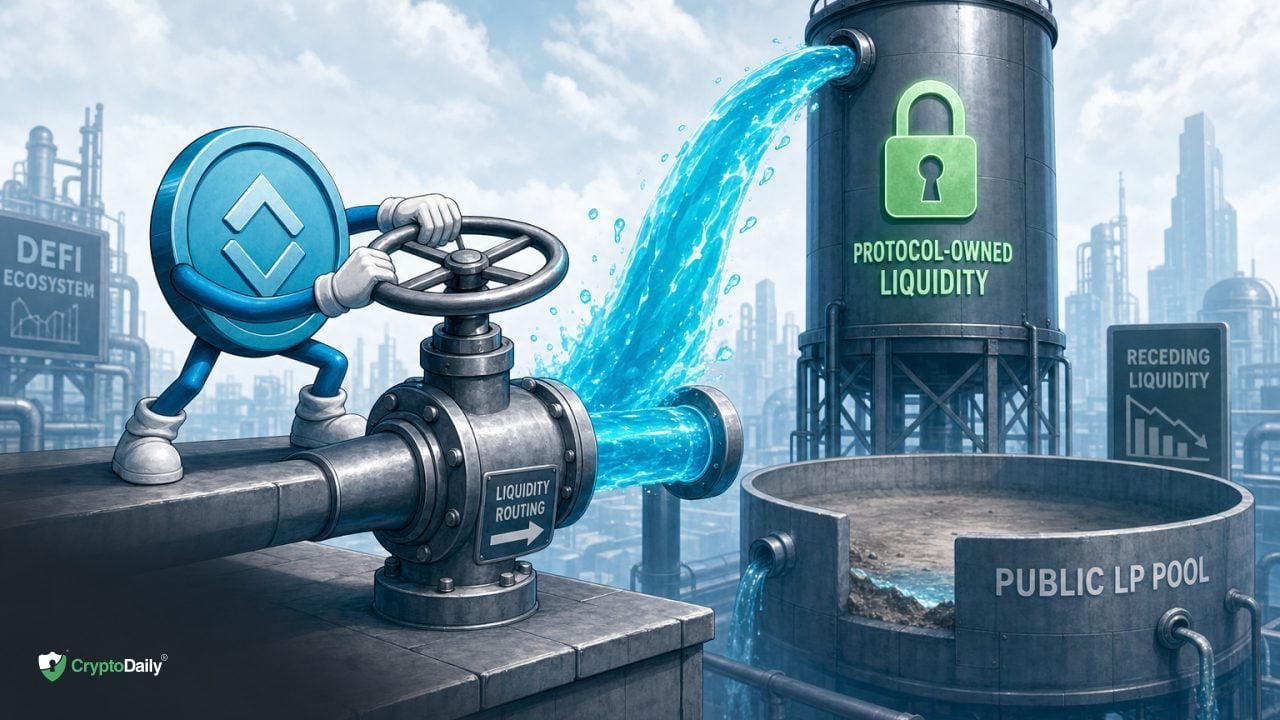
DeFi projects are getting tired of paying rent for liquidity. Instead of endlessly funding yield farms, more teams are buying and running their own LP positions. That shift has a name: protocol-owned liquidity.
This piece breaks down how POL works in plain language, who it suits, and the trade-offs you should weigh before a DAO points the treasury at a DEX. We’ll talk structure, budgeting, metrics, and the failure modes people don’t like to admit.
It matters right now because big protocols are making real moves on-chain to control their markets, from stablecoin launches to buyback programs. If you steward a treasury or just care about better execution, this is for you.
Protocol-owned liquidity is when a project uses its own treasury or revenue to seed and own its market-making inventory on DEXs. Instead of renting anonymous liquidity with incentives, the protocol deposits assets into pools, holds the LP positions, and actively manages depth and fees. Teams do it to cut slippage, reduce ongoing emissions, align incentives, and keep liquidity live through rough markets.
- Own the spread: keep consistent depth where users actually trade
- Spend once, manage forever: lower long-term cost than perpetual farming
- Align incentives: protocol benefits from fees and tighter execution
- Operational load: needs active risk and inventory management
How does protocol-owned liquidity actually work?
At its core, POL is a project becoming its own DEX market maker. The DAO or company funds a pool with treasury assets, receives LP tokens (or a position NFT on concentrated AMMs), and then manages that inventory to keep spreads tight and slippage low. Fees generated by trading flow back to the protocol, offsetting cost.
There are a few ways to acquire the LP stack. Some protocols simply deploy stablecoins or ETH from the treasury into the base pool. Others “bond” by selling their native token or future rights in exchange for LP tokens from the community. A third angle routes a slice of protocol revenue to buy and grow LP positions over time.
On concentrated liquidity AMMs, POL looks like a banded strategy: you set ranges around the active price, rebalance when markets move, and decide whether to run tight bands for low slippage or wider bands to reduce churn. It’s market making, just fully on-chain and usually rules-based.
Pro tip: Treat POL like inventory. Measure your mark-to-market PnL, not just fee APR. Fees can flatter your dashboard while your inventory silently bleeds on big price moves.
What are the trade-offs versus rented liquidity?
POL isn’t a free lunch. You swap recurring emissions for capital at risk and operational complexity. The right call depends on your token’s maturity, volatility, and the depth you actually need for users to transact without ruining their price.
Here’s a quick side-by-side look at the common options:
Approach Strengths Weaknesses Best For Protocol-Owned Liquidity (POL) Durable depth, aligned incentives, fee capture Capital tied up, IL risk, needs active management Stablecoins, core token pairs, mature protocols Liquidity Mining (Rented) Bootstraps fast, flexible across venues Ongoing token emissions, mercenary capital churn New launches, short-term campaigns Market Maker Agreement Professional inventory/risk management Counterparty risk, fees/retainers, often off-chain Centralized exchange liquidity, tight spreads CEX Listing Only Retail access, fiat ramps Limited on-chain depth, dependency on exchanges Broad distribution post-launch
If you’re overpaying for temporary TVL that vanishes when rewards fade, POL can be cheaper and more reliable over a full market cycle. If your token is highly volatile or thinly traded, the inventory risk might overwhelm fee income, making rented liquidity or a hybrid approach smarter until volume stabilizes.
Where does POL make the most sense right now?
Two categories stand out: stablecoins and base pairs for your native token. Stablecoins crave dependable depth because users expect near-zero slippage. And base pairs (like TOKEN/ETH or TOKEN/USDC) define the entire price discovery experience for your community.
A concrete example: in July 2026, Aave governance authorized the Aave Finance Committee/MainnetSwapSteward to acquire 8 million GHO and deploy DEX liquidity using treasury assets, with explicit USDC and USDT budgets of $10,000,000 each to support GHO launches and runway. That’s a major protocol choosing to provision on-chain liquidity directly from its treasury rather than leaning on short-term farming (Aave Governance (forum)).
For governance tokens, POL can make sense once the project has steady volume and a clear utility loop. Before that, it’s easy to tie up capital in inventory that doesn’t turn over. Many teams run a blended model: core depth via POL on the main pair, plus time-boxed incentives for long-tail pairs or new chains.
How do projects fund and structure POL?
There are four common funding routes: direct treasury allocation, bonding (sell the token at a discount for LP), revenue redirection (earmark fees into LP), and opportunistic buybacks into LP during drawdowns. Your choice reflects risk appetite and cash flow.
We’re seeing more DAOs redirect revenue, at least temporarily. On July 3, 2026, Fluid (Instadapp) launched The Fluid Reserve with a structured buyback, directing 100% of Ethereum-mainnet protocol revenue toward token buybacks in the program’s first month and linking the first on-chain transaction. That’s a textbook move to recycle protocol income into market support rather than constant external incentives (Fluid / Instadapp blog).
Governance should set guardrails: size the initial deployment, define triggers for rebalancing or pulling liquidity, and pick an execution steward with on-chain transparency. Aave’s approach, delegating to a Finance Committee/MainnetSwapSteward, is one model that balances accountability and speed for on-chain management (Aave Governance (forum)).
For concentrated AMMs, document ranges, auto-compound behavior, and inventory thresholds. Decide whether fees are harvested into the same pool (to compound) or routed to treasury. Write this down; your future self and your tokenholders will thank you.
Will owning your own LP actually keep spreads tight?
Usually, yes, if you put liquidity where trades happen and you rebalance. But depth is about shape, not just size. A small amount in the right ticks often beats a big, lazy position sitting far from the active price.
There’s also a useful datapoint from July 2026: a research paper on arXiv reconstructing the Uniswap protocol-fee switch reported a non-detection of large short-run average changes in active liquidity or local depth after take-rate cuts. In plain English, LPs didn’t stampede out immediately when the protocol’s fee share changed, which hints that near-term depth can be resilient to fee tweaks compared with what people fear (arXiv (Wen‑Ting Wang)).
For POL, that finding supports a practical takeaway: execution quality hinges more on where and how you place liquidity than on shaving protocol-level fees by a few basis points. Track your 1% depth, the effective spread during peak hours, and how often orders eat through your range. If the KPIs hold, users will feel it.