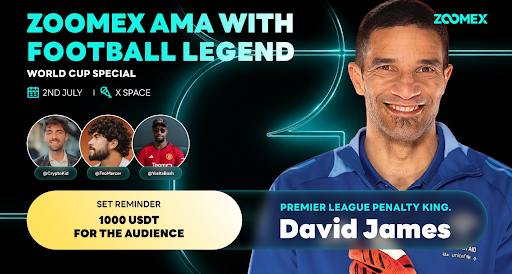
- James said real pressure for keepers comes in the silence between shots.
- At Liverpool, City, Portsmouth and England, preparation shaped James.
- For traders too, instinct works only when built on the right information.
Fernando Aranda hosted the session, which covered the knockout round, penalty psychology, goalkeeping philosophy, and England’s legitimate chances of winning the whole thing, a position James held without qualification and with obvious enjoyment.
The session continued the five-part charity initiative running across the series.
Zoomex is committing 1,000 USDT per episode to a charity of each football guest’s choosing, rising by an additional 5,000 USDT if the prediction proves correct.
James picked England to win the World Cup and nominated the UEFA Foundation as his charity of choice.
Last defence, last line, last save
The episode opened with a question every keeper answers differently, how do you describe the pressure of facing an unrelenting barrage of shots when your team is being outplayed?
James reframed the premise.
“I think the pressure is when you don’t have so much to do. When your team’s attacking and they’re not scoring and it goes down the other end and you’ve got to make the big save. That’s when the concentration has got to be there.”
He carried that logic across a career that spanned Liverpool, Manchester City, Portsmouth, and 53 caps for England.
The goalkeeper who is in the zone does not fear the next shot. He invites it. The trader who has done the homework does not fear the next candle. The preparation has already decided what happens next.
With the Congo goalkeeper the previous night, the opposite had been true. England were creating chances. The keeper was alert because the game required him to be.
“If you’re in the zone, then just keep shooting, keep shooting, because I’m going to be there.”
He was facing volume, but volume keeps a goalkeeper sharp. The danger is the long silence between saves.
The read on the England versus Congo game itself was direct. England won, which was the most important thing, but the Congo goalkeeper was exceptional for sixty or seventy minutes.
He had to be, James said, because England were creating the chances that required exceptional saves.
When Harry Kane’s header went in, and shortly after a thunderbolt from range made it two, the game was decided.
“There was a belief that there was going to be a second. And that’s where, the best goalkeepers in the world, they accept that goals go in, but don’t worry about the scoreline. They just say, OK, that shot beat me. Next shot, I will save. There’s no nerves.”
He was immediately thinking about the next fixture: Mexico at the Azteca. “Other than the final, it doesn’t get much better than that.”
He meant it as a compliment to the occasion, not a warning about the difficulty.
Penalties are about preparation, until they are about instinct
The panel spent substantial time on penalties, partly because the tournament had already produced defining moments in shootouts, and partly because the psychology maps almost exactly onto what traders describe as system versus gut reaction.
James described the two modes a goalkeeper can operate in during a shootout.
The first is pure preparation: the water bottle, the information, the tendencies logged from five or ten previous penalties by the same player, foot placement, the angle of the run-up, which way the non-kicking arm drops, whether there is a stutter in the approach.
All of that gets processed and the goalkeeper explodes at the last possible moment.
The second mode is instinct, and instinct, he said, can be wrong.
“When I thought I was the best goalie in the world and no one was going to beat me and I dived the wrong way, it was all instinct and sometimes your instincts are wrong. The more information you have, arguably, the better your instincts get.”
Crypto Kid connected it immediately.
“That phrase is very applicable to trading as well. Like the more information that you have in front of you, the more data that you can analyse, the better your instinct and ability to predict market movements get.”
Farouk had asked whether the goalkeeper’s rituals and routines in a shootout are natural or practiced. James was clear.
“My practice would be imagining the penalty shoot-out, imagining the crowd, even to the point where, if you’re playing in the Azteca, then you’re imagining being at one end or the other and what this is going to be like. And then you imagine yourself, how do you stand in that goal?”
Jordan Pickford’s approach has evolved over years from shouting and making faces to something more controlled. Whatever the method, James was confident it was rehearsed, not spontaneous.
On Bono specifically, who had already made a reputation in this tournament for his penalty-saving presence, James was thoughtful.
He had watched Bono in the last World Cup doing a particular movement with his feet: stepping one way, going the other. In subsequent shootouts, Bono was doing something slightly different.
“Now I’m thinking he’s doing something different because he knows everyone’s seen what he does. So the next penalty shootout in Morocco, the striker will be saying, “I think I know what you’re doing, but are you going to do something?”
The reputation itself becomes a variable. By the time the striker has processed what Bono is likely to do, Bono has already changed it.
You cannot learn to jump higher, you can learn to prepare better
Theo asked whether James had ever made a save and known in real time that it was a highlight moment.
The answer was yes, occasionally, but less often than people might assume, and for a reason worth sitting with.
“It’s very rare, especially with an experienced goalkeeper to be able…