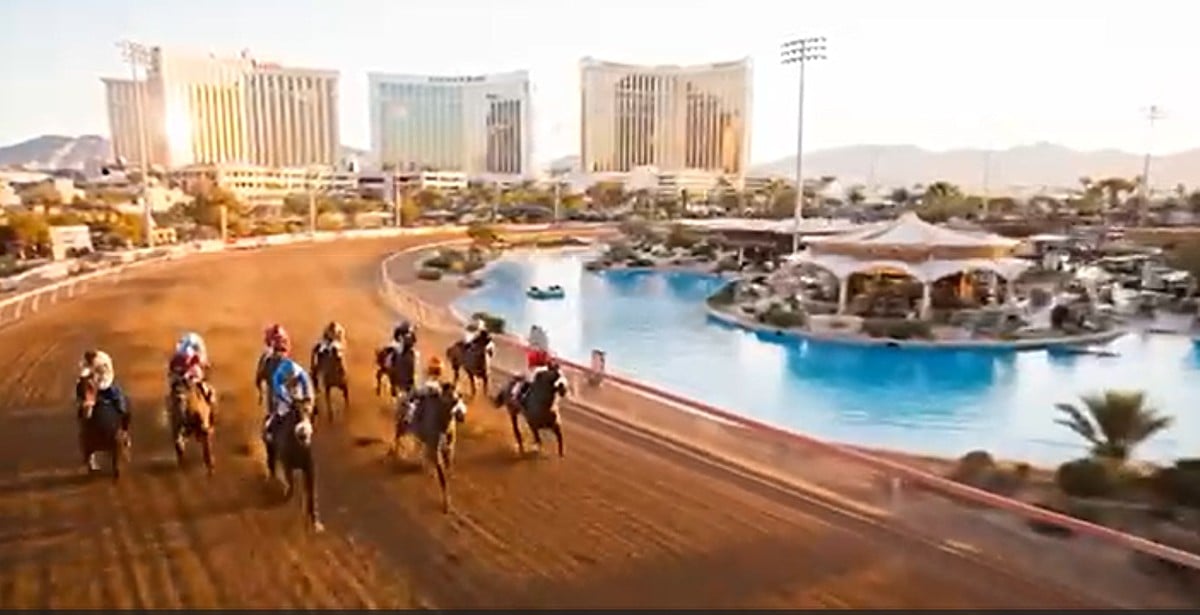
Chip Meyers stares out from his high-rise residence at a construction site no one imagined could exist a short while ago — the future home of the Oakland A’s. Every year, Las Vegas keeps doing things no one thought it would. A Major League Baseball team. Formula One. The Super Bowl. If all that can happen here, Meyers asks, why not a racetrack?
A rendering of Chip Meyers’ dream, the Las Vegas Downs race track, situated somewhere between Mandalay Bay and the M Resort south of the Las Vegas Strip. (Image: Chip Meyers)Meyers is best known for Hilt, his Bitcoin ATM company that lets people buy and sell crypto with cash. But for the past year, he has focused on something far more analog: building Las Vegas Downs, a thoroughbred racetrack directly on Las Vegas Boulevard.
Chip and Louise Meyers attend the 2025 Breeders’ Cup at the Del Mar Thoroughbred Club in California.He says the idea grew out of conversations with longtime locals — including friends from his USC days who now run a major construction firm.
“We kept on asking what was missing from this city,” he told Casino.org on Wednesday. “It’s two and a half million people now. It’s the sports capital of the world. Best restaurants in the world. So much to do.”
Horse racing, they all agreed.
Meyers grew up in Livingston, New Jersey, going to the Meadowlands regularly with friends. “I watched the Triple Crown every year,” he says. “Horses were on the cover of Sports Illustrated.” His wife Louise’s family owned trotters and raced at Hollywood Park. Her mother chaired a California racing organization.
Shrinking or Opening?
Meyers believes the West is facing a racing vacuum. “California racing is having a difficult time and really been retracting,” he says. “There are no more tracks in Northern California. There are three tracks left in Southern California. And there might be one track left in a few years, which is Del Mar.”
Santa Anita and Los Alamitos, he warns, may not survive long-term. Turf Paradise in Arizona is trying to reinvent itself, but the region’s racing footprint is shrinking.
“With that,” he says, “there’s an opportunity to do something in Las Vegas.”
He began researching the city’s racing history last August, when he shifted his attention to the project full-time. There were three previous attempts:
- Las Vegas Park (1953) — a fraud plagued thoroughbred track that lasted 13 race days
- Thunderbird Downs (1963–66) — a short lived track for thoroughbred and quarter horses that suffered from constant ownership turmoil and clashing with casino interests
- Las Vegas Downs (1981–83) — a Henderson greyhound track where horse racing survived only one month before the property was foreclosed on
Las Vegas is different now — wealthier, more global, more sports-driven.
“The ultra wealthy are still flocking to Las Vegas,” Meyers says. “All the hotels that are kind of higher end are sold out. The rates are just through the roof.”
He wants to build something that fits that market: a high-end, international-style racing experience.
Meyers envisions Las Vegas Downs as part of a global racing circuit — linked with the Saudi Cup and Dubai World Cup to create what he calls a “desert Triple Crown.”
Different Track
Meyers’ plan is bold: a 55 acre racetrack built between Mandalay Bay and the M Resort, one of the few remaining stretches of land on Las Vegas Boulevard large enough to hold it.
“When you come in from California, when 40,000 people drive in a day, the first thing they’ll see is this magnificent track,” he says.
The season would run 60 race days, Thursday through Saturday nights, November 1 through April 1 — when Las Vegas’ weather would not be an obstacle. The grandstand would seat at least 20,000, expandable to 40,000.
A rendering of Chip Meyers’ dream, the Las Vegas Downs racetrack, situated somewhere between Mandalay Bay and the M Resort south of the Las Vegas Strip. (Image: Chip Meyers)“We believe we can sell 20,000 seats a night,” he says. “People are always looking for things to do here.”
The nightly purse would be enormous. “About one and a half million dollars each race day,” he says — the highest average purse card in the country.
Unlike California tracks, Las Vegas Downs would not be a racino. “We’re not going to have a casino,” he says. “We’re not going to compete with the casinos.”
Instead, the track would serve the Strip’s existing resorts, not compete with them.
“It’s heads in beds for the hotels,” he says. “They’re going to send their people over there for three hours. Their high rollers, hopefully. Then they’ll go back to the Bellagio or the Venetian.”
The track would allow horse wagering but nothing else.
To make that possible, there’s a huge regulatory fence to jump. Nevada would need to adjust the historic requirements of the Nevada Pari-Mutuel Wagering Act. In effect since July 1992, they require 200 hotel rooms for pari-mutuel licensing. Meyers says he has already met with casino operators and regulators.
“I think they would back us,” he says. “I think the Gaming Control Board will back us. We need to get it into legislation probably in 2027.”
Horse Cents
The project’s estimated cost is $550 million, including the training center. Meyers says he already has half that committed from outside investors. The rest would come from a private club modeled after Hong Kong’s Jockey Club, where members pay six figure fees and collectively own horses.
A rendering of Chip Meyers’ dream, the Las Vegas Downs racetrack, situated somewhere between Mandalay Bay and the M Resort south of the Las Vegas Strip. (Image: Chip Meyers)“Our club will be 1,000 members,” he says. “They will own a piece of the track and be a syndicate owning horses as well.”
Members would have year-round access to the club, even when racing isn’t in season. In the summer, the 40 acre infield would transform into an attraction — possibly a surf wave, an equestrian jumping facility, or a tennis complex.
“We’re creating a year-round experiential venue,” he says.
He also says debt financing is an option, following the model used by most major Strip resorts, which lease their real estate from companies like Vici Properties.
“The land cost is about $125 million,” he says. “Maybe we can raise that. Maybe someone could lease us the land.”
Compared to the A’s stadium — a multibillion dollar project — Meyers argues his plan is modest.
“Is $550 million outrageous to build something really unique in Las Vegas?” he asks. “I don’t think so.”
Ethical Blinders?
Meyers acknowledges a cultural shift away from employing animals for human entertainment, but says it can be surmounted by how well the horses are treated.
“I know the younger generation especially is very interested of a lot of social causes that maybe my generation didn’t know about because of social media,” he says. “But I’ve seen what the Saudis and Dubai and in Hong Kong, how they treat horses, and how it’s so ingrained in their culture. They’re almost treated like gods.”
To support a racetrack, Meyers says he plans a wi…